
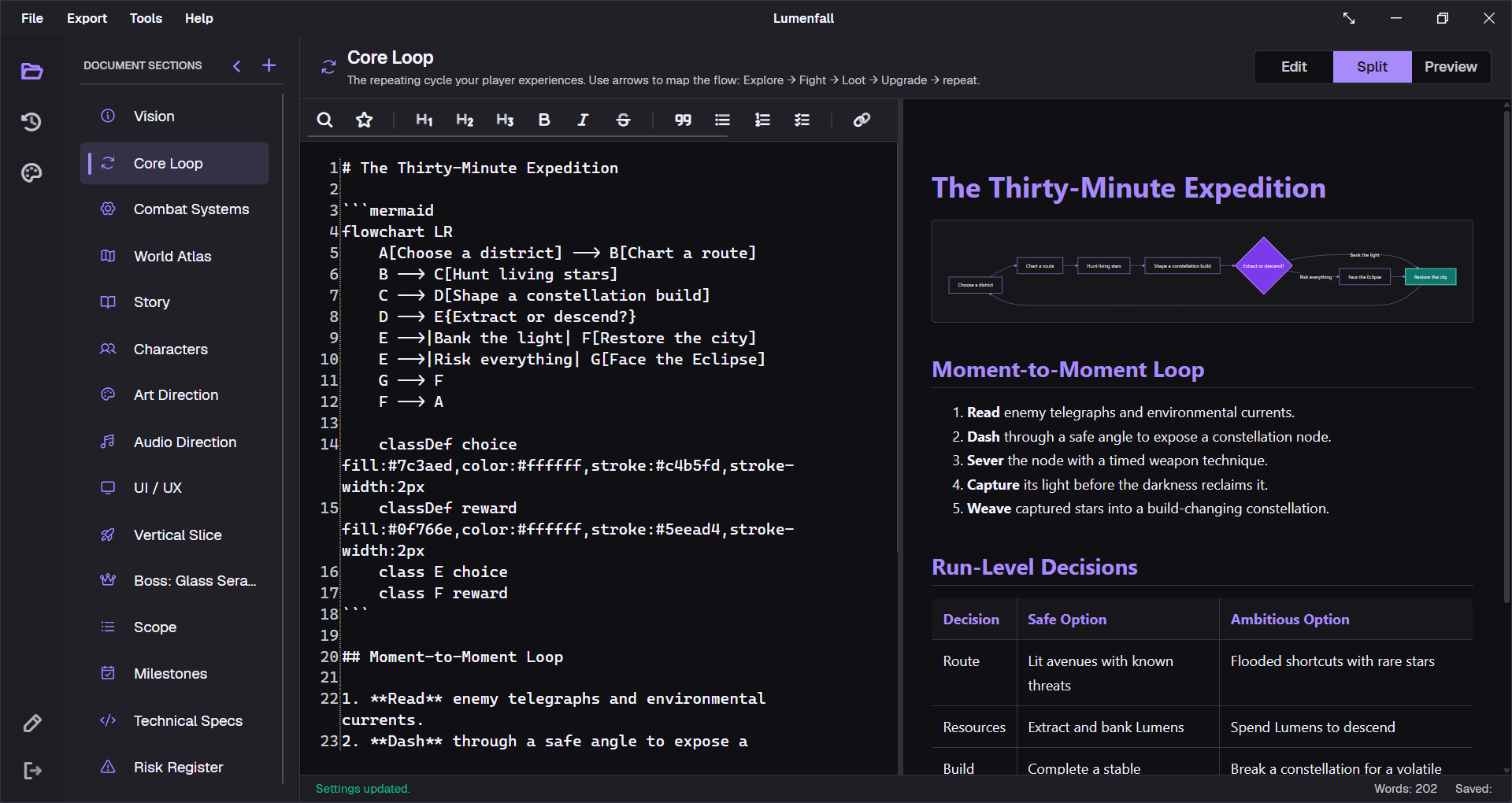
What this template helps you decide
Map the hook, objectives, branches, dialogue dependencies, rewards, failure rules, and implementation requirements in one concise quest spec. The prompts are written for production use, so each section leads to a rule, dependency, measurable target, or test case.
The download is a portable `.gddkit` project. It includes formatted Markdown, tables, a version entry, and Mermaid diagrams where a state or flow is easier to understand visually.
Quest brief
Write the question or problem that makes the player care now.
Flow
flowchart TD
Objectives
Objective text should describe the desired outcome, not expose an internal trigger.
Keep the spec small enough to review. Link this focused document from the main GDD, then record material changes in the project changelog.
How to use it with your team
- Name the player-facing goal before describing implementation.
- Replace every placeholder with a rule, number, owner, or open question.
- Mark assumptions that require a prototype or playtest.
- Review dependencies with design, engineering, art, audio, and QA.
- Export the approved version to PDF and keep later decisions in the changelog.
Use it as part of a complete GDD
A focused system spec should not duplicate the project vision, overall scope, or shared technical constraints. Keep those in the main game design document template and use this file for the details that need concentrated review.